
7 Lessons from Bryce Hedstrom
For decades, language classrooms have often been organized around grammar lessons: verb charts, conjugations, and memorizing rules. While grammar certainly has a place, what if we have been putting our emphasis in the wrong place?
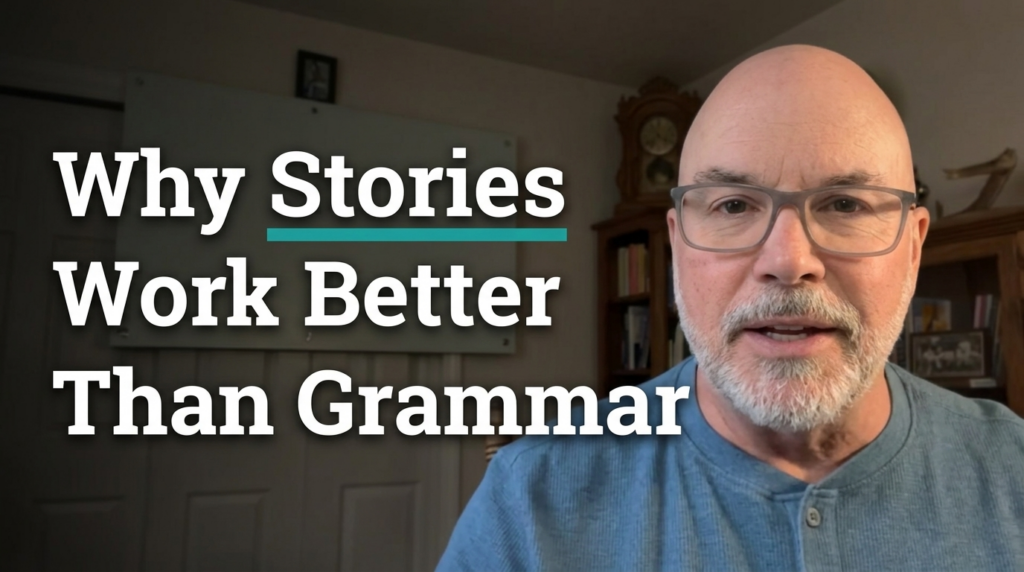
In the first episode of The Storytelling Language Series, I had the pleasure of talking with teacher trainer, author, and speaker Bryce Hedstrom. Bryce has spent nearly four decades teaching languages and more than twenty years training teachers around the world.
His message is simple, but powerful:
Students acquire language through meaningful communication. They need to understand messages, interact with others, and engage with stories—not simply memorize grammar rules.
During our conversation, we explored storytelling, reading, classroom culture, comprehensible input, and practical strategies teachers can begin using right away.
Here are some of the biggest takeaways from our conversation.
1. The Class That Changed Everything
Bryce was not always a storytelling teacher.
During his third year of teaching, he had a class that had earned a reputation as his most difficult group of students. They were considered poor language learners, and they were not making much progress.
Then Bryce attended a workshop on TPRS (Teaching Proficiency through Reading and Storytelling) and decided to try a completely different approach.
He began teaching through stories.
The result surprised him.
“I’m gonna try some of these strategies of teaching with stories. And I’ll be danged if that class within like a month, they were enthused about learning, they were getting more fluent, they could tell stories, they could understand and comment.”
The class that had once seemed impossible became the class that changed his entire approach to teaching.
As Bryce explained:
“This was my worst class. Now it’s my best class.”
That experience showed him something he would carry throughout his career: when students receive meaningful language they can understand, they can surprise us.
2. Storytelling Doesn’t Mean Ignoring Grammar
One of the biggest misconceptions about storytelling is that teachers stop teaching grammar.
Bryce does not believe that.
Instead, he believes grammar works best when it supports communication.
Rather than spending weeks teaching isolated grammar units, he uses what he calls pop-up grammar: short explanations that happen naturally while students are engaged with language.
He explained:
“I’ll ask students, ‘What makes this say I am talking?’ Or, ‘How do we know it’s they are talking?’ And I’ll ask them questions about the grammar.”
The difference is that grammar becomes connected to meaning.
Instead of:
“My six-week unit on teaching the subjunctive that I had developed beforehand…”
Bryce focuses on brief moments that help students understand the language they are already using.
“Just short, little grammar lessons to help them.”
For Bryce, grammar is a tool. It supports communication, but it does not replace communication.
3. Reading Is Essential
Stories do not end when a teacher finishes telling them.
Students need to read.
Bryce believes reading is one of the most powerful ways students continue acquiring language because it allows them to encounter words and structures repeatedly in meaningful contexts.
When choosing books for students, he emphasizes the importance of finding materials that students can successfully understand.
“They need to be vocabulary controlled books where they don’t introduce too many new words at once.”
The goal is not simply to have students complete a reading assignment.
The goal is to help them become readers.
Bryce uses novels and stories with his students at different levels, including his Latin classes today.
As he explained:
“Reading is just a huge, huge thing.”
He recommends activities such as whole-class reading, individual reading, and conversations about stories.
The key is that students are not just decoding words. They are building meaning.
4. The Three Cs of Great Classroom Books
When teachers choose books for language learners, not every book is a good fit.
A book may be a wonderful piece of literature, but that does not automatically mean it is appropriate for students who are acquiring a new language.
Bryce shared the framework he uses when evaluating classroom readers:
“It has to be comprehensible, it has to be compelling, and ideally it’s cultural too. So the three C’s: comprehensible, compelling, and cultural.”
Students need language they can understand.
They need a story that captures their attention.
And they need opportunities to connect with cultures and perspectives beyond their own.
Bryce believes the best classroom books bring all three elements together.
“Many of them are books like you write, that they take place in the culture, and they’re written by somebody from the culture that understands it.”
For language learners, a story is not just a way to practice vocabulary. It is a way to experience another world.
5. Bryce on Los Ojos de Carmen
One of my favorite moments of our conversation came when Bryce talked about using my novel, Los Ojos de Carmen, with his Spanish students.
Before discussing my book specifically, Bryce explained what he looks for in classroom novels: stories that are comprehensible, compelling, and cultural.
Then he connected those ideas to his experience teaching Los Ojos de Carmen.
“Los Ojos de Carmen and your book, I think that was the first book of yours that I was ever aware of. I taught it with my Spanish three students and they really liked it.”
Bryce explained that the novel gave his students an opportunity to explore Ecuador, geography, and culture while developing their Spanish.
“Your book is filled with culture and geography and just what it feels like to be in Ecuador and including like the Galapagos Islands.”
He also appreciated how language was naturally repeated throughout the story, helping students encounter important structures in context.
“I loved how your book just kept repeating phrases, especially like with the subjunctive that Spanish three students need to really start acquiring.”
He also highlighted the value of the expressions and language students encounter while reading.
“There’s idiomatic expressions that I thought were extremely valuable in the book.”
But perhaps the comment that meant the most to me as an author was his final observation:
“But it’s just a good story. Kind of a coming of age story that my students always appreciated and really, really liked a lot.”
As authors, we spend countless hours writing, revising, and wondering how our books will connect with readers. Hearing from an experienced educator that students enjoyed the story and connected with the culture behind it was incredibly meaningful.
6. Real Communication Creates Confident Students
One of Bryce’s favorite classroom strategies is what he calls the Special Person Interview.
Instead of practicing artificial dialogues, students talk about themselves, their interests, and their experiences. Then that information becomes part of the class conversation.
Students are not using language because they are completing an exercise.
They are using language because they want to know another person.
Bryce explained how this approach developed:
“I realized it’s not meaningful when I go around the whole classroom and ask every single kid, ‘What’s your name, what’s your name, what’s your name?’”
Instead, he changed the focus:
“But if I talk to one specific person, ‘What’s your name? You have a nickname? What do you like to do?’ and just find out about them, then it becomes purposeful and meaningful.”
That simple shift transformed his students’ confidence.
Bryce shared that before using this approach, even advanced students doubted whether they could have a real conversation in Spanish.
But after experiencing meaningful interaction, their confidence changed.
“Now kids that are in first year, at the end of the year, I ask them the same question. I say, if I dropped you off, could you talk to somebody for an hour in Spanish? And they go, ‘Yes, of course, Señor. You think we’re stupid?’”
For Bryce, this confidence comes from real communication.
“It’s real language interaction and it’s repeated over and over.”
7. Start Small
Changing the way we teach can feel overwhelming, especially for teachers who have required textbooks, curriculum standards, or assessments.
Bryce’s advice is not to completely transform everything overnight.
Instead, start small.
“If you can just jump in. Not everybody can do that. You know, they’re constrained maybe by their curriculum or the required textbooks, required tests they have to give. But jump in as much as you can.”
He recommends beginning with simple changes:
Read a novel together.
Ask more questions.
Add storytelling.
Try a Special Person Interview.
Give students more opportunities to interact with meaningful language.
Bryce believes questions are one of the most powerful tools teachers have.
“Asking the questions is the biggest thing to get them fluent.”
Teachers can begin with simple questions and gradually move toward deeper conversations.
“Ask yes, no questions, true or false, either or… and then the highest levels are why or how, and then what’s going to happen. And what do you think about this?”
His advice is practical and encouraging:
“Work stories in, work reading in as you can, or special person interviews. Work those in little by little and then just keep following your regular curriculum.”
Small changes, repeated consistently, can completely transform a classroom.
Final Thoughts
One of my biggest takeaways from this conversation is that students do not fall in love with grammar. They fall in love with stories. Grammar certainly has its place, but stories provide the meaningful context that makes language memorable and alive.
If you are looking for ways to increase engagement and help your students acquire Spanish more naturally, I hope this conversation gives you new ideas to try in your classroom.
Start small. Keep it comprehensible. Keep it compelling. Keep it meaningful.
Your students may surprise you.
You can also listen to this interview as a podcast or watch it on YouTube.
Happy teaching!
Verónica Moscoso
Author-Publisher, Veromundo
COMING SOON
Listen to the Full Episode
 Episode 1: Why Stories Work Better Than Grammar
If you would like to hear the complete conversation with Bryce Hedstrom—including our discussion about TPRS, reading, Special Person Interviews, classroom novels, and practical strategies for teachers—you can listen to the full podcast here.
Or, if you prefer reading, you can find the complete transcript below.