
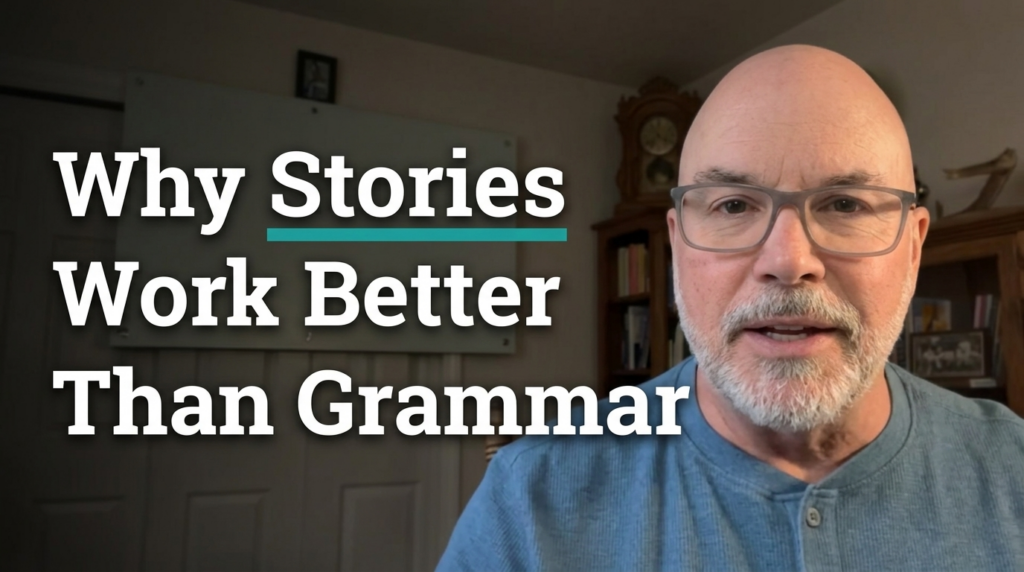
An Interview with Bryce Hedstrom
In this first episode of The Storytelling Language Series, I had the pleasure of speaking with language acquisition expert Bryce Hedstrom about the power of storytelling in the language classroom.
Verónica: I’m your host, Verónica Moscoso, and this is the very first episode of a series of conversations about the power of storytelling in the language classroom. Today we’re going to explore why using stories is more effective than focusing on grammar. To talk about that, we have a guest: Bryce Hedstrom. So, Bryce, welcome. Thank you for being the first guest in this series.
Bryce: I’m thrilled to be here. I’ve known you through other people for years, and I’ve always admired your work, so I’m really happy to be here.
Verónica: Thank you so much, Bryce. I’m very happy to have you, not only because of your expertise, but also because everyone who knows you speaks so highly of you as a person. It’s an honor to have you. So, for how many years have you been teaching languages?
Bryce: About 39 years in total. It’s been a great experience all the way through. I’ve loved it the entire time. It’s been more than a job or even a career—it feels like a calling, to help people communicate with others in different languages.
Verónica: You’ve also been very successful in teaching and training teachers. How long have you been doing that?
Bryce: I’ve been training teachers for about 20 years, and the last eight years full-time. It’s been wonderful. I eventually decided to leave the classroom even though I loved it and was successful, because I felt I could have a greater impact by training teachers full-time.
Verónica: You’re also an author. Can you tell us about the books you write?
Bryce: I’ve written about 24 books. Some are shorter, and most are geared toward training teachers. One of my bestsellers is High Impact Reading Strategies, where I help language teachers teach reading effectively using four main strategies and lots of examples.
Verónica: Have you been using stories instead of focusing on grammar in your classroom?
Bryce: Yes. I started using stories in my third year of teaching. I attended a workshop on TPR storytelling, and I had one middle school class that was very difficult—very disengaged, not successful with language learning. I decided to try storytelling strategies with them, and within a month everything changed. They became enthusiastic, more fluent, they could understand and tell stories. That class went from my worst to my best. From then on, I used stories at all levels.
Verónica: Do you teach grammar at all, or do you mostly use stories?
Bryce: I mainly teach through stories—telling stories, reading stories, acting them out with students. But I do “pop-up grammar.” That means I briefly explain grammar when it naturally comes up or when students ask. It might be a 15-second explanation, not a full grammar unit. Some students are very interested in grammar, so I’m happy to explain it to them individually.
Verónica: You mentioned TPRS. Can you explain what that is?
Bryce: TPRS was developed by Blaine Ray in the 1980s. It uses storytelling, student actors, and constant interaction in the target language. Students help build the story by responding to questions. It’s a very engaging method, and I still use parts of it today, though I also include music, reading, and special person interviews.
Verónica: Can you explain the special person interview?
Bryce: Yes. In a special person interview, you ask students about themselves and then share that information with the class.
It works like this:
• You ask the student questions (second person)
• The student answers (first person)
• Then you report it to the class (third person)
It creates meaningful communication and raises engagement. I also quiz students on what they learn about their classmates. It started very simply—I just wanted students to correctly use basic phrases like “me llamo…” But over time it became a powerful tool for real communication. At the end of the year, students who used this method feel confident speaking Spanish in real-world situations. They believe they can actually communicate.
Verónica: Do you read with your students?
Bryce: Yes, absolutely. Reading is essential. Even now, I teach Latin part-time, and I use the same approach. I teach high-frequency verbs in context so students can start reading real stories quickly.
I’ve had third graders finish their first novel and discuss it fluently. Reading is a core part of language acquisition.
Verónica:
What kinds of books are appropriate for language classrooms?
Bryce: The key is matching the student’s proficiency level. The best books are:
• Comprehensible
• Compelling
• Cultural
We call these the three Cs. Books should not introduce too many new words at once. The story must be understandable and interesting, and ideally culturally meaningful.
Verónica: Where do you find these kinds of books?
Bryce: Some come from independent authors, teacher networks, conferences, and websites like ours or TPRS-based publishers. But the best way is networking with other teachers—asking what works, what students enjoy, and what has been successful.
Verónica: What was your experience when you switched from grammar-focused teaching to storytelling?
Bryce: I did get pushback. Some teachers said my students didn’t “know grammar,” meaning they didn’t memorize conjugation charts. But my students could speak, understand, read, and write. The results spoke for themselves. Over time, I saw that language develops best when students are exposed to meaningful communication, not isolated grammar instruction.
Verónica: How did you convince administrators that your method worked?
Bryce: Students wanted to take my classes. Enrollment increased dramatically. At one point I had over 300 students. There were fewer behavior problems, higher engagement, and strong language outcomes. That convinced administration that something was working. Later, my AP classes also showed strong results and high pass rates, with students from all backgrounds succeeding.
Verónica: What advice do you have for teachers who want to start using storytelling?
Bryce: Start small.
• Use simple stories or leveled readers
• Ask lots of questions (especially yes/no, either/or, who/what/where questions)
• Focus on interaction, not grammar instruction
Students acquire language by understanding messages, not memorizing rules. Even 10 minutes a day of storytelling or reading can make a big difference.
Verónica: Thank you so much, Bryce. There is so much more to talk about, and I hope we can continue this conversation in future episodes.
Bryce: It’s been a pleasure. Thank you for inviting me.
Final Thoughts
One of my biggest takeaways from this conversation is that students do not fall in love with grammar. They fall in love with stories. Grammar certainly has its place, but stories provide the meaningful context that makes language memorable and alive.
If you are looking for ways to increase engagement and help your students acquire Spanish more naturally, I hope this conversation gives you new ideas to try in your classroom.
You can also listen to this interview as a podcast or watch it on YouTube.
Happy teaching!
Verónica Moscoso
Author-Publisher, Veromundo