veromundo.store

Day Labor Site Offers Few Jobs
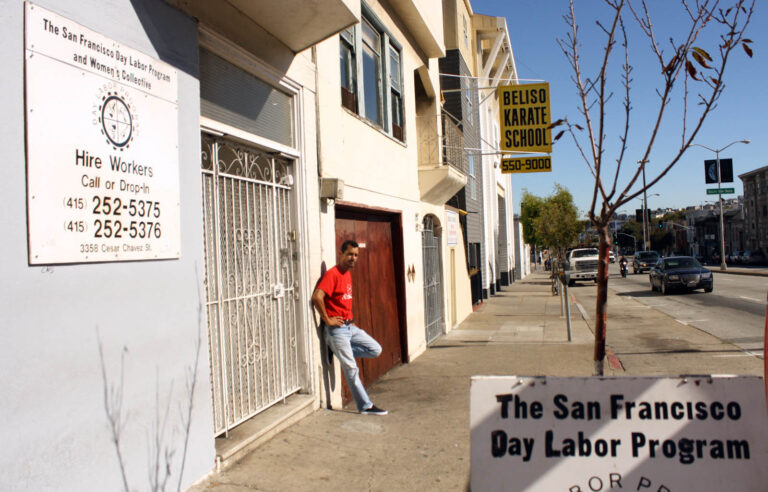
A woman nobody has seen before uses the office phone. A man from the street comes asking for socks. The hungry are welcome to get lunch. That’s an ordinary Wednesday at the Day Labor Program center. “I have a feeling of protection coming here,” said Ismael Flores while standing outside of the center. He’s a three-week-old member who comes “to look for work, meet friends and chat.” That in fact was what the Day Labor Program at 3358 Cesar Chavez St, was meant to do, according to its mission statement. The two-story space on the same street where day laborers line up for work was founded in 1991. Even during the boom economy of 2006, a member could expect only one job a week. Nevertheless, day laborers keep showing up from Monday to Saturday to a center that’s become a refuge where every morning there is coffee and bread and each day of week brings a new offering: Tuesdays, a doctor gives check ups; Wednesdays volunteers gives haircuts and make lunch; Fridays a teacher gives an English class and once a month, advanced students serve as chiropractors. The program has about 140 members, and even now, prospective members continue to attend an orientation meeting. Even if jobs are rare, picking up work on the street is riskier and at least being in contact with the Day Labor Center gives workers a network, they said. Take Alfredo Mendoza, for example. Two women moving from San Francisco to Oakland recently picked him up on Cesar Chavez to help with the move.  When he finished in Oakland, however, they refused to pay him. “I don’t speak English and couldn’t figure out what happened,” said Mendoza. Although work is infrequent, at least getting a job through the Day Labor Program, Mendoza is more likely to get paid. Employers who call the center are informed to pay at least minimum wage, provide safe conditions and give them breaks. They know they’ll be held accountable for on-the-job-injury. Employers leave their names and contact information and they get the name of the worker too. “It is safer for the employer and for the employee,” said Hannah Pallmeyer, a volunteer program job developer. At the center, only members get the jobs but nobody gets turned down if they want a cup of coffee or to use the services. On a recent Wednesday, Carlos Montana a 22-year-old from El Salvador helped bring in heavy boxes of donated juice. “I like being here. I know the people,” said Montana who isn’t yet a member, but likes to use the computers available at the center. In a recent orientation Aguiar told the five attendees, “The program can’t do miracles. This is only one of the things you can do to find work.” Having said that, he also explained what the center had to offer. The five men listened intently and later three of them signed up. Members get an ID. “You can show the ID to the police if they ask you, and they know you belong here,” said Aguiar. Members give $1 per month to the center. The money goes to a fund managed exclusively by them. They have used the money to get uniform t-shirts, make “hire us” signs and to organize a Father’s Day carne asada in the park. Some of the obligations, the men at the orientation were told, include delivering flyers from the day labor program to mailboxes, and cleaning clean the center once a month, a job that Aguiar assured them, “takes about 15 minutes.”  They don’t have to participate in any of these jobs until after they get their first job. On Thursdays and Saturdays one program employee and three day laborers sweep 26th and Cesar Chavez streets. This outreach began to improve relationships with neighbors who had complained about human waste and garbage on the streets. Pallmeyer, job developer, said that it was a great feeling when, a couple months ago, a member of the community offered strawberries and told them how grateful he was for the job they were doing cleaning the streets. “That has been the best memory that I have from working here,” she said. Mission Local DECEMBER 13, 2009

Day Labor Site Offers Few Jobs Read More »

Election 2010: Gioia leading in race for County Supe

Many of the local elections in Tuesday’s direct primary vote were still too close to call as of 9 p.m., but at least one county seat appears safe for the incumbent. A confident John Gioia thanked supporters, including Richmond Police Chief Chris Magnus and city councilmen Jeff Ritterman and Tom Butt, at an election-night party Tuesday for their work, as early results favored the 12-year incumbent over political newcomer and Richmond native Mister Phillips in their battle for the District 1 County Supervisor seat. Early results had Gioia leading Phillips 79 percent to 20 percent, with 23 of 104 precincts reporting. The early returns are largely affected by votes made prior to Tuesday – mostly mail-in and absentee ballots. Full results will likely be announced late Tuesday night or early Wednesday, at www.cocovote.us. “I felt optimistic,” Gioia told the crowd at Salute Restaurant in Richmond. “I feel good. It’s great representing this community. I grew up here and I think there are a lot of things to improve in West County, but I think we’ve done a lot of things.” Despite the early returns, Phillips wasn’t ready to concede defeat. “I think that it’s encouraging,” Phillips said of the numbers. “It’s only 20 percent (of the total vote), and I’m within 5,000 votes. So we’re going to be up for a while looking at results, because this race is not over. This race is still winnable.” Mail-in and absentee ballots are generally thought to tend more conservatively than in-person balloting, although with the growing popularity of mail-in voting, that trend is beginning to change. Phillips, who announced his candidacy for the supervisor position over a year ago, faced an uphill battle the entire way to unseat Gioia, a generally popular incumbent. As of the most recent campaign finance reporting date, in late May, Gioia had raised and spent over $100,000 in campaign contributions. Phillips, on the other hand, managed to raise $4,678 and spent just over $5,000. Phillips’ shoestring campaign primarily focused on how life for West County residents has remained mostly unchanged during Gioia’s tenure on the board of supervisors. Ed Bear, a Gioia supporer who has known the supervisor for 15 years, seemed confident Gioia would emerge victorious. “I’m surprised someone was even running against him,” Bear said from the rally. The race took a turn for the nasty in the final weeks, when West County residents received a campaign mailer detailing Phillips’ 2009 run-in with the sheriff’s department that landed him in county jail after he allegedly crossed a police line at the scene of a murder-suicide in the Montalvin Manor neighborhood. Phillips apparently told sheriffs’ officers during the arrest that he was running for supervisor, and that arresting him was “a big mistake.” The mailer quoted Jim Bickert, the president of the Contra Costa County Deputy Sheriffs’ Association as saying, “This clearly showed a misplaced sense of importance and was an irresponsible act for a person who says he’s ready to lead.” On Sunday, Phillips responded to the mailer with an email to the press pointing out that he was never prosecuted, and that the Office of the Sheriff found that the involved deputies had shown “unbecoming conduct.” The mailer was paid for by an independent expenditure committee called the Contra Costa Coalition for Jobs. According to ibabuzz.com, the committee’s top funder is BI Land LLC, a company that is owned by Samir Kawar, a developer who has been working on a development proposal in the Tassajara Valley. In the two biggest statewide races, Meg Whitman and Carly Fiorina won the GOP nominations for governor and U.S. senate, respectively. Whitman will face two-time former governor Jerry Brown in November, while Fiorina will challenge incumbent Senator Barbara Boxer. According to several reports from around the Bay Area, turnout for Tuesday’s primary appeared low. A Field Poll conducted this week indicated that about a third of the state’s registered voters planned to cast a direct primary ballot. At the Marina Bay Harbor Master’s Building polling station in Richmond, election inspectors said there’d been little action all day. Inspectors said they expected only about 100 voters to show up at their polling place, although they had 600 blank ballots, in both English and Spanish, at the ready. But at 5 p.m., there were no voters present there at all, although one man stopped by to drop off a mail-in ballot. “I’ve voted since I was 18 years old,” said Tim Dunbar, a Marina Bay resident. “I just do it every time – it’s not so much about the issues, it’s about the principle of the thing.” In other early local returns, there appeared to be a bit of a surprise in the race for County District Attorney. Antioch city councilman and deputy D.A. Mark Peterson led former County Superior Court judge Dan O’Malley 51-34 percent with 155 of 628 precincts reporting, with Elle Falahat, a former Ventura County deputy D.A. trailing with close to 15 percent of the vote. O’Malley out-fundraised both his competitors by a wide margin and figured to enjoy a level of name recognition – both his father and sister have been Bay Area district attorneys – than either of his competitors. Incumbent County Assessor Gus Kramer was also leading a crowded field of challengers after early returns in his race with 56.95 percent of the tallied vote. John Nejedly was next highest at just under 25 percent, while Bob Brooks had collected just under 13 percent of the vote. If no candidate in either the D.A. or Assessor’s race receives over 50 percent of Tuesday’s vote, the top two will compete in a November runoff. In the race to become the next County Sheriff/Coroner, Concord Police Chief David Livingston led Deputy Sheriff Brian Kalinowski 56-44 percent, a margin of close to 8,000 votes. Russell Watts was leading Karen Thibodeau by close to 12,000 votes in the race to be the county’s tax collector. Measure D, the bond proposition that would charge West Contra Costa Unified

Election 2010: Gioia leading in race for County Supe Read More »

Mission Women Honored

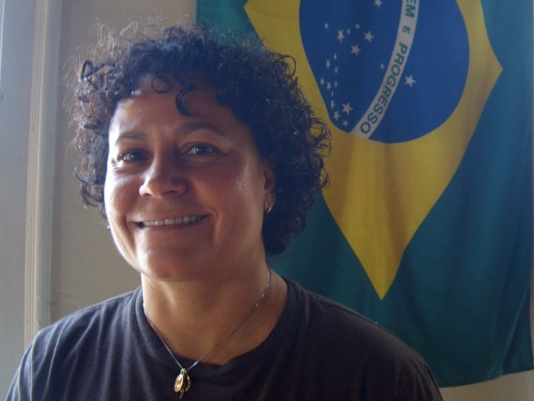
The 10 Women Campaign will honor 10 women Saturday at ODC for their work as bridge builders who bring together disparate communities. The award recipients include Mestranda Márcia “Cigarra” Treidler,  the president and artistic director of ABADÁ-Capoeira in San Francisco and Karen Heisler co-owner of Mission Pie and co-founder of Pie Ranch. “The quiet and persistent activism of these women is deep and unquestionable moving forward,” said Jo Keiter the founder of Flyaway who launched the idea of The 10 Women Campaign seven years ago. Building Bridges Between the Urban and the Rural “Sometimes I feel I was born at the wrong time,” said Karen Heisler referring to what she calls the dominance of commercialism and degradation of self-sufficiency. But then she changes her mind and decides, no, now is exactly the right time.  “We are on the brink of finding more collaborative models,” she said. Heisler, a San Francisco native, earned a degree in Conservation and Resource Studies from UC Berkeley in 1991 and went to work for a Federal Environmental Agency. Although her job was satisfying, she decided that government policy alone would not solve our problems. “I wanted to work at a ground level with people,” she said. In 2002 Heisler, Nancy Vail and Jered Lawson purchased 14-acres in Pescadero, CA. Their vision was to use the property as a non-profit and teach food system education while practicing sustainable farming. The wedge-like shape of the land gave the land its name, Pie Ranch. Since 2005, Pie Ranch has operated as a working farm, hosting youth from regional high schools to participate in farming including Mission High School and now John O’Connell High as well. When students begin, Heisler said, they have fears—of bugs or dirt.  “But then, being in the farming environment, they start to tune in and feel a sense of community and love.” Kids learn to do physical work together, farm, bake and cook fresh food. Heisler said she sees dramatic changes in their eating habits and in their  relationships with one another. Apart from Pie Ranch, Heisler is the co-owner of Mission Pie, a bakery and coffee house at the corner of 25th and Mission streets. The food there is fresh and organic, they recycle and compost, and they buy and collaborate with nearby organic farms, Heisler said.  “We want the farms in the area to thrive,” she said. Students too. Mission Pie hires at risk youth interns. Heisler said she is no farmer but “ just a person with a love and a value for agriculture.” Building Bridges Between Cultures Márcia Treidler was 17-years old when she started training in Capoeira in her native Rio de Janeiro, Brazil. She didn’t have a female role model. Back then, much more than now, the martial art was male dominated, but Treider persevered. “The bumps in the road made me better and stronger,” she said remembering those years. After 15 years of training she became “Mestranda,” the second highest level for a Capoeira teacher of ABADÁ-Capoeira, a form that integrates two traditional styles of this art. Capoeira is an afro-Brazilian martial art believed to have been developed by slaves. It involves singing and playing musical instruments as well as physical training— a mixture between a dance and a fight. Today Treider is known by Mestranda Márcia or “Cigarra” a capoeira nickname that means cicada.  Her studio is on the second floor at 22nd and Mission streets. “Whether they are doctors or undocumented immigrants, here they find a place of hope,” Treider said of her students. The Mestranda first came to the United States as a performer in 1991 and soon after moved here. She was the first Brazilian to teach ABADÁ-Capoeira in the United States and she is now the regional leader of this form. In 1997 she was granted permanent residency in the United States after receiving a National Interest Waiver as an “Alien with Extraordinary Abilities.” Her school operates as a non-profit that promotes Brazilian culture. Treider runs a free program for Brazilians and free to low cost classes for children and youth.  One of her  her goals is to enrich disadvantaged communities and the lives of people from all backgrounds. “The only purpose that we have here is to make you a better person,” Treider said. Heisler , Treidler and eight other women will  receive their awards this Saturday at ODC Dance Commons. For more info go to http://flyawayproductions.com/10women.html Mission Local OCTOBER 24, 2009

Mission Women Honored Read More »

Fire season approaches for Richmond

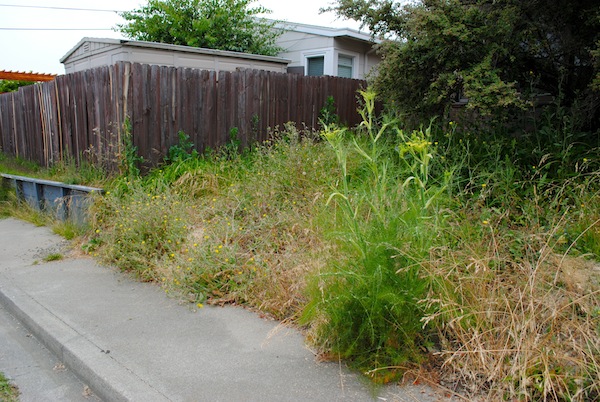
More fires are reported on July 4th than any other day of the year in the United States, according to the National Fire Data Center. Last year there were five wildfires in Richmond on the 4th of July. There were none this year but “We’re anticipating a lot today,” if people continue to use fireworks said battalion chief Erick Newman, who is on duty during this observed holiday. The high numbers of fires during this holiday are usually the result of a combination of dry grass, brush and fireworks. But the danger of fire in Richmond doesn’t stop after Independence Day — fire season is just starting. Depending on weather conditions, the California Department of Forestry and Fire Protection determines when fire season begins. This year it started two weeks ago, in mid-June. Residents need to trim overgrown grass and leaves. Photo by Veronica Moscoso. “Usually when we have a late winter, we have a late summer and our fire season sometimes will go until November,” said Rod Woods, a firefighter who has spent 24 years working with the fire department in Richmond. The Richmond Fire Department has always been pretty busy during fire season. Last year there were 72 wildfires in Richmond during this period. Because of this year’s long rainy season, there’s a serious threat of wildfires this summer. A wet winter leads to the growth of weeds and grass that dry out during the summer, raising the probability of a blaze, according to Woods. Undeveloped areas in Richmond are susceptible to wildfire. Grass, weeds and brush grow out of control in open lots. Most of the undeveloped areas in Richmond are within East Bay Regional Park boundaries. These include — but are not limited to — Point Pinole, Alvarado Park, El Sobrante Ridge and Hills, Nichol Knob and Wildcat Canyon Park. “That probably hasn’t burned in years, so that means that there’s a lot of growth,” said Woods of Wildcat Canyon Park. Communities surrounded by wildlands are at risk of wildfires. Photo by Veronica Moscoso. However, areas where human development mix together with undeveloped wildland are also potentially in danger during fire season. Firefighters call these areas “wildland/urban interface.” The Wildland/Urban Interface Fire Protection Program has identified four common components of interface fires: 1. Low relative humidity, high temperatures, and high winds often are in place before a fire starts. 2. Human activity such as arson, debris burning or downed electrical wires. 3. Many involve the destruction of homes were built with combustible material or have especially vulnerable features such as wood shingle roofs. 4. Considerable combustible materials surround the home, such as woodpiles and fences. While environmentalists and foresters often believe that a natural fire is healthy for forests, and that fires in non-urban locations should be allowed to burn, homeowners in these areas expect fire protection of their structures. One of the most destructive fires in the history of the United States was a wildland/urban interface fire. It occurred in October 1991 in the East Bay hills of Oakland; 25 lives were lost and more than 3,000 structures were destroyed. View of an area of Richmond Heights. Photo by Veronica Moscoso. Richmond has no record of a blaze of the magnitude of the Oakland Hills fire, “but we have the potential to have that though,” said Woods. “We have a lot of areas that are considered urban interface,” said Woods and cited the Richmond hills and the neighboring El Cerrito hills. As a result of the Oakland hills fire, the Bates Bill (AB 337) was passed in 1992 requiring the California Department of Forestry and Fire Protection to work with local governments identifying “Very High Fire Hazard Severity Zones,” which are areas of the city considered to be the most at risk for wildfires. For the Contra Costa County map developed to show high-risk areas, click here. These zones in Richmond include all of Point Richmond, Carriage Hills, and the El Sobrante Hills neighborhoods. Residents living in these areas are required by city ordinance to maintain adequate fuel and fire breaks between structures and flammable vegetation. One side of the flyer the Richmond Fire Department hands out with the precautions to take during fire season. Woods said that people that live in wildland/urban interface areas have to be especially careful to cut overgrown grass, trim leaves, clean pine cones on their roofs and remove anything that has potential to ignite during a fire. In order to reduce potential fire hazards, the Richmond Fire Department hands out a flyer with a list of measures that residents who live in wildlife/urban interface areasneed to take in order to protect their property, including clearing dry grass, brush and other combustibles from at least thirty feet around each home. According to CAL Fire, last year there were 4,657 wildfires in California that burned 80,990 acres. The fire department hopes that Richmond residents, who live in high danger fire zones, take the necessary precautions to protect their property in the event of fire. July 5, 2010 Richmond Confidential

Fire season approaches for Richmond Read More »

Graffiti: Who Pays for Cleanup?

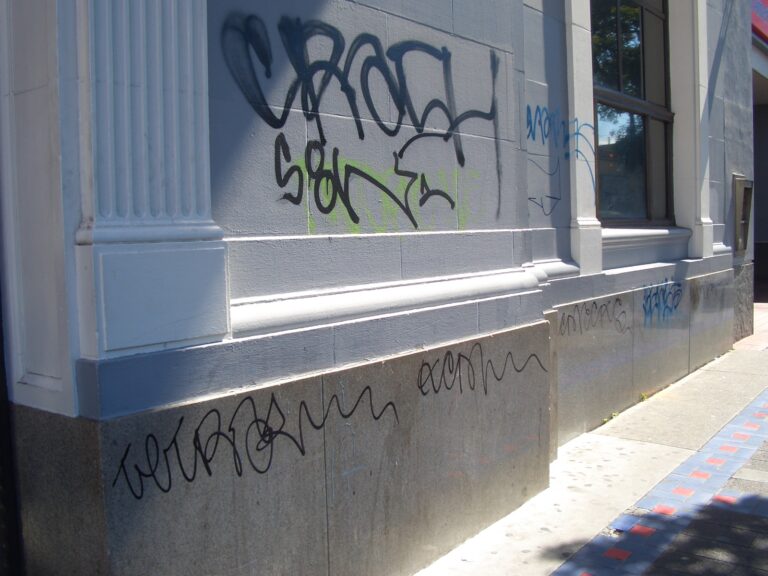
When the owner of a dry cleaners in the Mission District received graffiti notices from the city, it never occurred to her to ask her landlord to take care of the tagging. Fixing property damage was not part of her lease agreement, but the letters were directed to her business name, so she assumed she was responsible. What the owner never understood — a confusion among the majority of small-business owners interviewed recently in the Mission District — is that the landlord, not the business owner, is responsible for cleaning graffiti.  The assumption, owners said, comes from the official letters they receive. Mission Loc@l also found that the confusion is underscored by ambiguous information on the website for the Department of Public Works. “I’m tired of painting,” said the owner of the dry cleaners, who asked not to be identified. She’s had the business for seven years and said lately her store gets tagged every week. And every week she paints the wall. She assumed she had to, but with graffiti complaints growing — they jumped 148 percent in District 9 in 2008 — she said the responsibility and cost of taking care of it has become too much. Roberto Jimenez, office manager of Caldera Castillo Enterprises, a notary business between 21st and 22nd streets, also assumed incorrectly that the store was responsible. “The business receives the notice from the city,” he said in an effort to explain why. Since 2004, the city’s Graffiti Removal Ordinance has required property owners to remove graffiti or request a hearing within 30 days of receiving a letter from the Department of Public Works. If the owner fails to comply, the city initiates proceedings to clean the graffiti, for a minimum of $500 plus attorney’s fees. Christine Falvey from Public Works said that even though the ordinance makes the property owners responsible, “in many cases, the ground floor merchant is obligated to maintain the property via their lease agreement.” If the lease doesn’t require it, the landlord has to fix it. However, many tenants said they made no such agreement but nevertheless received the letters and assumed responsibility.https://d-39563088771805726960.ampproject.net/2108052321001/frame.html The confusion over who is responsible doesn’t stop with the letters. Business owners also get conflicting information from the department’s official site. The Public Works website has useful information, and clearly states the ordinance and the landlord’s responsibility. But click through for more information and this brochure turns up, stating: “If you own or manage property or operate a ground-floor business that has been graffiti-tagged, you are legally responsible for removing the graffiti.” The ordinance includes the word “etched” and “buildings,” but as Falvey said, does not “specify that windows are included.” And, as a matter of course, “we do not send property owners notices of violation for etched windows,” she added. Gris Savedra, an employee at the Fat Greek Store, said store owners are having a hard time keeping their businesses open in this economy, and graffiti notices stress him out. “The graffiti on the windows is impossible for me to clean,” she said. Both she and her employer assumed they were responsible for cleaning it. Jimenez, the office manager of Caldera Enterprises, said he too was sure the law required him to replace an acid-etched window. A Mission restaurant owner who preferred to remain anonymous said the problem isn’t just the lack of clarity around the ordinance. “Even if small businesses aren’t required by law to remove tags, they are going to do it out of fear that their landlord will not renew the lease,” he said. Some business owners said their landlords willingly stepped in to take care of business. “The landlord paints the graffiti every day and every night they do it again,” said Arif Rana, owner of Best Center, a gift shop at 2317 Mission St. He noted the freshly painted wall next to his store. Store owners who agree in their lease to take care of graffiti have the same rights of appeal as the owner. If they get vandalized frequently or they don’t have the means to remove the tags, they too can ask for a hearing, according to Public Works.Some business owners said San Francisco should try New York’s methods: In 1999 former mayor Rudy Giuliani started a free graffiti-removal program called Graffiti Free NYC. In New York, they said, neither landlord nor tenant are responsible. By Verónica Moscoso Mission Local OCTOBER 6, 2009

Graffiti: Who Pays for Cleanup? Read More »

Junetenth Richmond 2010

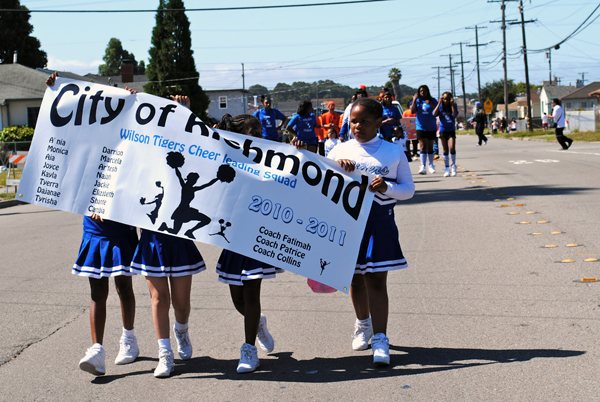
Politicians, dancers, a Corvette convoy, horses and more paraded from 21st Street and Cutting Boulevard to 37th Street and MacDonald Avenue celebrating the annual Juneteenth Festival this Saturday morning. The festivities continued in the afternoon at Nichol Park, where people gathered to enjoy live music, food and sneak a peak at about 40 community and business booths that were offering their services. The Juneteenth Festival is a commemoration of the announcement of the abolition of slavery in Texas on June 19, 1865, two and a half years after Abraham Lincoln’s emancipation proclamation. The announcement in Texas made the enslaved legally freed in all the United States. Juneteenth is now a recognized holiday in 37 states. Although this is a celebration of African American heritage, in Richmond everyone felt welcome to join. “Pride and purpose, that’s what Richmond is all about,” said Mel Davis, a member of the National Brotherhood Alliance, the group that organized the event, while standing in front of Nichol Park and speaking by microphone to the crowd. It was a family event for the city residents and from visitors like Eric Assata who lives in Oakland. “I came to have a good time. It’s a close getaway,” he said while holding hands of three little girls, who were his granddaughter, grandniece and niece. “It’s like Cinco de Mayo for us,” said Martin Hernandez, who was born in Mexico. “We want to share with them this important day,” Hernandez said referring to African Americans. “It’s good that it’s multicultural. We have to celebrate each other,” said Lynda Moore, a Richmond resident who commemorates Juneteenth every year with her family. She likes this event because “people come together and don’t act crazy,” she said. Although there was a heavy police presence, those attending the event seemed to be calmly enjoying the performances and the diverse booths. The booths represented everyone from shoes and jewelry sellers to sports teams like the West County Spartans Football, but most of them were for community organizations like the Brookside Health Center, a non-profit primary care clinic. Gregory Madison used to live in Richmond and came from Oakland to the Juneteenth celebration for the first time in five years. “I’m glad to see that it’s still going strong,” he said. June 21, 2010 Richmond Confidential

Junetenth Richmond 2010 Read More »

National Night Out Richmond 2010

In an effort to build community and prevent crime, the City of Richmond celebrated the 27th annual National Night Out Tuesday with block parties throughout the city. The city joined 35 million citizens around the country in celebration. Police officers and firefighters visited 24 different neighborhoods across Richmond that were holding block parties. City officials including Police Chief Chris Magnus, Mayor Gayle McLaughlin, City Manager Bill Lindsay and Fire Chief Michael Banks attended the kick-off ceremony and party held at the Target Store on Macdonald Avenue. The event offered music performances by The East Bay Center for the Performing Arts, free hot dogs and hamburgers, and an appearance by the Richmond Fire Department‘s demo unit, which showed kids what to do in case of a fire. A bounce house and the free face-painting clowns were also very popular. “What a pleasure it is to know that our crime prevention is working in the city of Richmond. This is a tribute to a collective effort in the city,” said Mayor McLaughlin, referring to the city’s decreasing crime rate. “People are working together and the city needs more of that.” For Chief Chris Magnus, the event was a great opportunity for residents to connect with the police, because “really we solve crimes through relationship-building,” he said. Magnus also mentioned the importance of neighbors working together to help prevent crime. “The police can’t be everywhere all the time, so it pays to have in the neighborhood folks that are looking out for each other.” Additionally, Fire Chief Banks said, “National Night out gives us an opportunity to send our message of fire safety throughout the city.” Other community organizations and business were also represented at the Target parking lot block party. For instance, nonprofit Building Blocks for Kids, the Contra Costa County Conflict Resolution Program and Target all had tables at the event, where people were giving out information about their organizations and handing out trinkets. City officials were also available to talk with residents. The elected officials left, however, to go on a community caravan along with police officers and firefighters to tour some of the other neighborhood block parties throughout the city. The tour gave the police officers an opportunity to get reacquainted with the residents of their beat. As residents heard the sirens of police cars and fire engines approaching their party, they clapped in excitement. Each neighborhood found its own way to connect with the community, and each party had its own feel. The Marina Bay block party at 1 Marina Lakes Drive set out tables hosted by the different condominium committees from the complex and encouraged residents to visit so people could walk around and get information on the different committees. They had cookies, coffee and fliers with information. The Richmond Heights block party at Tiller Park organized a potluck with music, hot dogs and kids’ attractions such as a face-painting fairy and residents dressed up as cartoon characters Winnie the Pooh, Gossamer and Belle (from The Beauty and the Beast.) “It’s good to see everyone in the community getting together and having a good time and see the police and fire department too,” said Belle, played by neighborhood resident Elizabeth Thompson. “It is a lot of fun.” “Anytime you bring people together is important,” said Michael Rogers, a Richmond Heights resident. “When police get to talk with the neighbors, I think it’s great.” Posted by Richmond Confidential on August 4, 2010

National Night Out Richmond 2010 Read More »

Richmond hosted children and youth summit

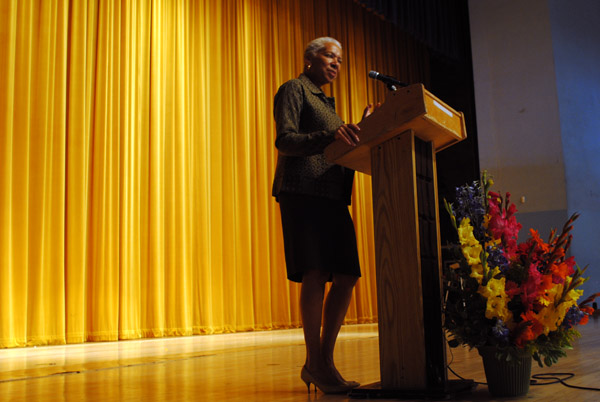
audience at the Youth-Senior Mentoring Project workshop quietly listened while 71-year-old, white haired volunteer Annie Stephens talked about her joyful experience as a senior working with youth. She described how enthusiastic young people were to meet seniors, and how they worked together on projects like making Christmas cookies or putting together a scrapbook. “It’s great when we have generations coming together and learning from each other,” said Stephens. The attendees of the Youth-Senior Mentoring workshop had a special interest in what Stephens had to say; they wanted to hear new ideas to nurture their own work with the community. This was only one of 25 workshops held during the 2010 Northern California Summit on Children and Youth, an event that took place last Thursday and Friday at the Richmond Auditorium. The conference brought together about 250 people who participated in different workshops focusing on education, health, community building, and innovative youth strategies. This is the third year this conference has taken place, and the first time Richmond has hosted the event. The initiative to hold the conference in Richmond came from the Richmond Community Foundation, a non-profit organization that works to revitalize the Bay Area’s poorest and most violent neighborhoods. “From now on, we want to make this Northern California summit into an annual event in Richmond,” said Jim Becker, vice president of development and programs at the Richmond Community Foundation. Becker says that the goals of the summit are to help people who work with children and youth get together, and to make sure that the areas of research, best practices and public policy are covered during the workshops and that the best speakers are provided. This year the summit’s theme was “A New Decade of Hope,” which Becker said alludes to the fact that over the last decade there had been many funding cuts to children’s services and education, to the point that cuts for youth programs have become the norm in California. “We’re in a new decade and we have to think differently. We can’t allow this to continue to happen,” he said. Attendees were mostly educators, members of nonprofit organizations, community leaders, elected officials, and representatives of businesses and area foundations. They came from cities throughout Northern California, but mostly were from the Bay Area. “We learned about helping youth while telling them the truth,” said Chasetta Miller, a teacher at a Head Start preschool program in Berkeley, after attending a workshop called “Creating Economically Empowered Youth and Communities.” Rhonda F. Harris, who is running for Richmond City Council this November, attended the workshops too. “When we come together with other organizations, we get ideas on how to guide our children and youth,” she said. Many attendees found the summit valuable, like Fred Davis Jackson, youth services coordinator at the Neighborhood House of North Richmond, a non-profit organization that provides services for those in need. “Maybe you will get a rehearsal on some things you know but still you will see a new insight and in general you can only gain from just being here,” he said. June 7, 2010 Richmond Confidential

Richmond hosted children and youth summit Read More »

Jobs Now Surpasses 1,000 Hires

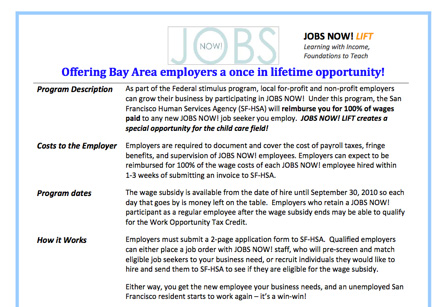
Finding a marketing expert to employ was no problem. The challenge for the boutique creative agency located in the Mission was finding the money to make the hire. Enter Jobs Now!, a city program funded by the stimulus to subsidize employment. “We found someone who had been laid off from a very successful company,” said Sir Less, the chief executive officer of Integrated Alchemy Media Inc. on 24th Street. The new employee, Less said, has helped the company go to the next level. Jobs Now! has surpassed its initial goal of placing 1,000 San Francisco locals in jobs between May 2009 and September 2010 by 138 placements. The program subsidizes 100 percent of employee’s wages and Bay Area companies are invited to participate as long as they hire un- or underemployed San Francisco residents who have a dependent child. So far 117 employees from the Mission have benefited from the jobs program. “When you put a person of that caliber to work, it generates more work,” said Less. Because of the new employee, his company has been able to get more projects and hire more contractors. Less said that his company has grown and when the program is over, they won’t need government subsidies to pay their new expert’s salary. Michelle Singletary, a 26-year-old single mother, was laid off from Levis six months ago and recently found work through Jobs Now. “With this program you start working immediately. I applied and the next week I had a job,” Singletary said. Singletary was placed in Laundry Locker Inc., a company based at 1530 Custer Ave. that provides door-to-door dry cleaning services throughout San Francisco. Arik Levy, the CEO of this company said that through Jobs Now they were able to hire two drivers, two operations workers and one sales manager. “We are growing since we started the program,” Levy said. The company is doing much more than it used to before. “A year from now, we think we can definitely keep them when the subsidy runs out,” said Levy about his new employees. Although the salary is subsidized with Jobs Now!, the employer is responsible for regular payroll taxes including FICA, SUI, SDI and worker’s compensation insurance. Despite of these employer expenses, Levy said the program “has been fantastic for us.” And Less said, “it is great what the program does, use the stimulus money to put people to work.” Since the program started in May, 3,777 eligible employees have applied and 1,138 have been placed in jobs, according to the last report. Roxana Vasquez-Morales, business account representative at the One Stop Career Link Center in the Mission said, “We try to match the clients with a job.” There isn’t a match for everyone immediately. Some applicants are waiting but the program will continue until next year and they are still taking applications. Interested employers and employees click here for more information. Mission Local DECEMBER 12, 2009

Jobs Now Surpasses 1,000 Hires Read More »

Naked Lunch Turns 50

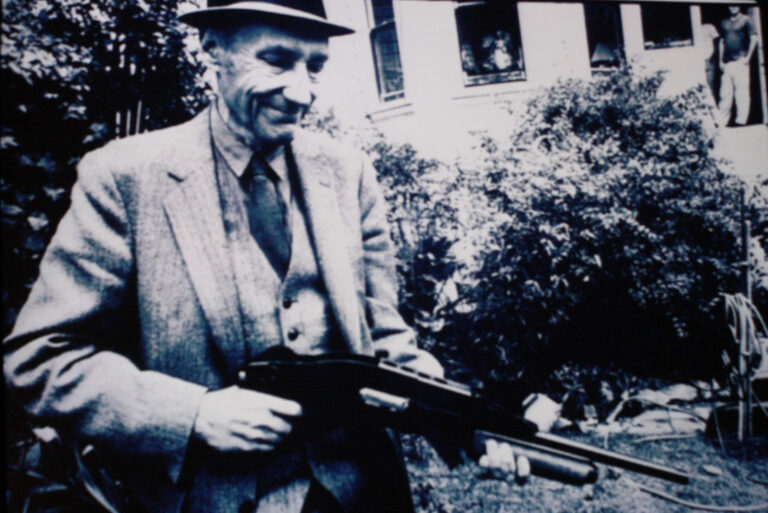
Pictures of a girl masturbating for an audience, a nude androgynous man being taken away by cops during Mardi Gras and one of William S. Burroughs, in front of a lie detector, were among the photographs shown at the San Francisco Art Institute, at the second of a three-day celebration of the 50th Anniversary of Naked Lunch, written by Burroughs. The lie detector, was, of course, “to test if he was lying.” said Charles Gatewood, a friend of the author and a photographer of the underground scene that Burroughs wrote about. The celebration, which started Friday with a round table discussion of the novel,  published in Paris, runs through Sunday. Contemporary writers will gather tonight at Amnesia Bar to read excerpts from Naked Lunch, considered a landmark in American literature because of its obscenity and the court case surrounding the story of a homosexual junkie. At the Saturday event, Burroughs’ friends shared their photos, videos and anecdotes of the author. “We both were junkies and liked getting high,” said Mel Clay, poet, play writer and Burroughs’ friend.  When Clay was 22, he went to Morocco with Burroughs. On more than one occasion, Burroughs and Clay went from doctor to doctor pretending that Burroughs had kidney problems so they could get a Domorohl, a prescription drug. “It is not the drugs that will kill you, it’s the lack of them,” said Clay, quoting Burroughs. A Skype screen was widely projected in the auditorium so the audience could hear Kathelin Gray speak from New Mexico. “William Burroughs was a shaman healer. That’s a side that not many people know,” said Gray, founder of the Theater of all Possibilities and close friend with Burroughs. Gray described personal moments, dreams, and supernatural events that connected them. V. Vale, the publisher of RE/Search, a magazine on counterculture topics, said she had trouble reading Naked Lunch. It wasn’t until the 1970’s that he became a real fan after reading an interview with Burroughs at the Atlantic Monthly Review. To close with the perfect finale, contemporary local authors will read excerpts of Naked Lunch Sunday night at Amnesia Bar, at 853 Valencia Street. “It is going to be more like a party,” said Peter Maravelis, City Light Bookstore events coordinator, a North Beach store that has sponsored the anniversary celebration. Maravelis said that Amnesia Bar is an intimate setting, far from the academic world, where people can relax and have a drink while listening to the excerpts of the book. Maravelis expects a younger crowd and likes closing the event at Amnesia because “it can evoke Burroughs spirit. “He was also a performer who liked rock and roll and was friends with Kurt Cobain and Jimmy Page,” Maravelis said of Burroughs. Mission Local NOVEMBER 22, 2009

Naked Lunch Turns 50 Read More »

Shopping Cart