Richmond mourns the death of Asama Ayyad
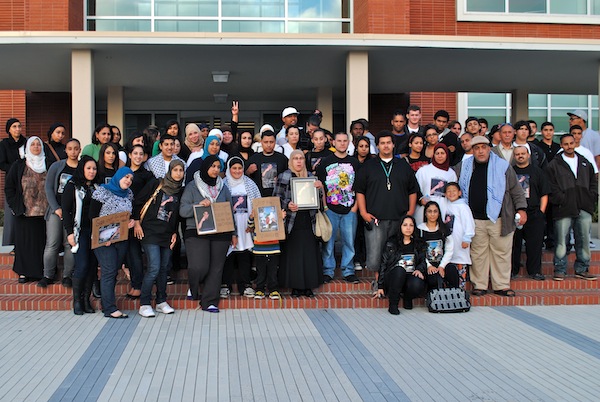
After he was shot while driving his car on the evening of June 25, 20-year-old Asama Ayyad drove back to the mosque in Richmond where he had been praying and volunteering just before the assault. Almost unconscious, he crashed into two electric poles at Cutting Boulevard. “There is no God but God and Mohamed is his prophet. To God we belong and to Him is our return,” he prayed in Arabic. Those were his last words. Ayyad had been shot in the upper right side of his torso, and by the time the police arrived he was unconscious. He was taken to the hospital and pronounced dead there. A 15-year-old friend who had been riding in the passenger seat survived being shot in the leg. The fatal bullet had come from a white van carrying four teenagers and a 20-year-old man; the van had followed Ayyad’s vehicle after he and his friend left a ceremony at the mosque that night. Nineteen-year-old Nickie Donald of Richmond has been charged with Ayyad’s murder; according to law enforcement he had mistaken Ayyad’s car for someone else’s and opened fire. Although the number of homicides in Richmond has dropped — according to the Richmond Police Department there have been 12 this year, nearly 50 percent fewer than at this time last year — violence remains an enduring problem for the city. In the two weeks since Ayyad’s murder, there have been two other shooting deaths involving young men in Richmond, those of 20-year-old Alan Torres and 18-year-old Emani Stephens. Ayyad’s friends and family remember him as a peaceful spirit who was respectful to his elders, helpful with the young, and who tried to avoid violence. “He had such a pure heart. He was like an angel,” said his mother Faisa Ayyad with tears in her eyes as she spoke about her son at an interview at the family’s home a few days ago. Last Tuesday, about 60 of Ayyad’s friends and family members showed up at the Richmond City Council meeting to express their sadness over the young man’s death and their disgust with violence. Most of them were wearing T-shirts bearing his picture. “His death has left a hole in the heart of many people in Richmond and El Cerrito,” his mother said sorrowfully. Ayadd’s family moved to the United States from Palestine more than three decades ago because they wanted to live in a safer place. Naim Ayyad, his father, emigrated 35 years ago; his mother joined her husband five years later. A hard-working couple, they opened a halal market selling Middle Eastern food and meat in Berkeley and raised their five children, three boys and two girls. Asama Ayyad was their fourth child. Although the family currently lives in El Cerrito, he attended Kennedy High School in Richmond and regularly attended Masjid Al-rahman, a mosque in Richmond. After some recent hardships, including Naim Ayyad having a heart attack a few years ago, the family sold the market and Asama Ayyad dropped out of school to help the family. Currently their family business is a Middle Eastern restaurant in Albany called Zaki Kabob House opened by the eldest son, 27-year-old Ramsy Ayyad. But despite the family’s hardships, Ayyad’s relatives say that the young man was looking forward to the future. In November he was planning to visit Jerusalem, where his parents are from originally. He wanted to get married and dreamed of having his own business one day. He also hoped to work for the California Highway Patrol. In order to make that possible, he wanted to get his high school diploma and was planning on taking classes soon to get his GED. On the evening of his death, Ayyad had left his part-time job at Whelan’s Cigar Store in Berkeley and gone to Masjid Noor, a Richmond mosque at 13th Street and Cutting Boulevard that was hosting a reunion for about 1,000 Muslims from California and other states. They were getting together for an annual Ijtimah, a gathering to pray, help each other, and remember Islamic values. Ayyad enjoyed helping and especially wanted to give a hand to his uncle, who was the cook for this large crowd. After dinner, some people stayed to sleep at the mosque, and others went home. After helping his uncle, Ayyad decided to leave, too. He was afraid for his beloved car, which was parked outside. The white 1999 Lexus that his father had given him as a present had become Ayyad’s project. The car was bought for cheap but Ayyad had spent time and all his savings fixing it and adding new features, like 24-inch rims, new paint and speakers. “The car was like his little baby,” said his cousin Noor Ayyad. Family members say that Asama Ayyad was aware of violence and gangs in Richmond, but wanted nothing to do with them. Just a week before, his 22-year-old best friend Samir Ayesh had been shot and killed in Hayward when he asked graffiti painters not to tag the walls of his house. So far the police have not caught the perpetrators, and his family members say that Ayyad had been very depressed about it. When his uncle asked him to stay longer at the mosque, Ayyad said, “I don’t feel comfortable being in this area and I don’t feel safe at all.” Ayyad left with his friend, a teenage neighbor who wanted a ride in the shiny white Lexus. The plan was to go for a ride and then go home, said his family. But at the traffic light on 22nd Street and Bissell Avenue, gunfire erupted from a white van that was following them, hitting the Lexus several times. Mortally wounded, Ayyad’s first instinct was to go back to the mosque, a safe haven of spirituality, family and community. The police have stated that the shooting was a case of mistaken identity, but Ayyad’s family thinks that the youngsters in the van were trying to steal the car. “I wish they had asked for the car,” said Kammal Ayyad, one
Richmond mourns the death of Asama Ayyad Read More »